OPTIMIZE, CONTROL
Drive your ROI with Qanty
Turn waiting time into actionable data.
In the U.S. economy, time is the ultimate currency. For a bank or healthcare provider, a crowded lobby isn’t just an annoyance—it’s a revenue leak. For an Operations Director, long lines represent a hidden tax on profitability and a direct pipeline sending your customers to the competition.

Queue Theory, Flow Optimization, and Customer Experience (CX) aren’t just buzzwords; they are the mathematical backbone of operational excellence. Discover how to turn passive waiting time into a competitive advantage.
Queue Theory is the mathematical study of waiting lines and service flows. Its business goal is to find the financial “sweet spot” between the cost of increasing service capacity (staff/infrastructure) and the opportunity cost of losing customers due to friction and delays.
Balancing cost and service. Often, U.S. businesses in retail, banking, or healthcare view lines simply as a sign of “high demand.” However, through the lens of operational intelligence, a standing queue is a symptom of process inefficiency.
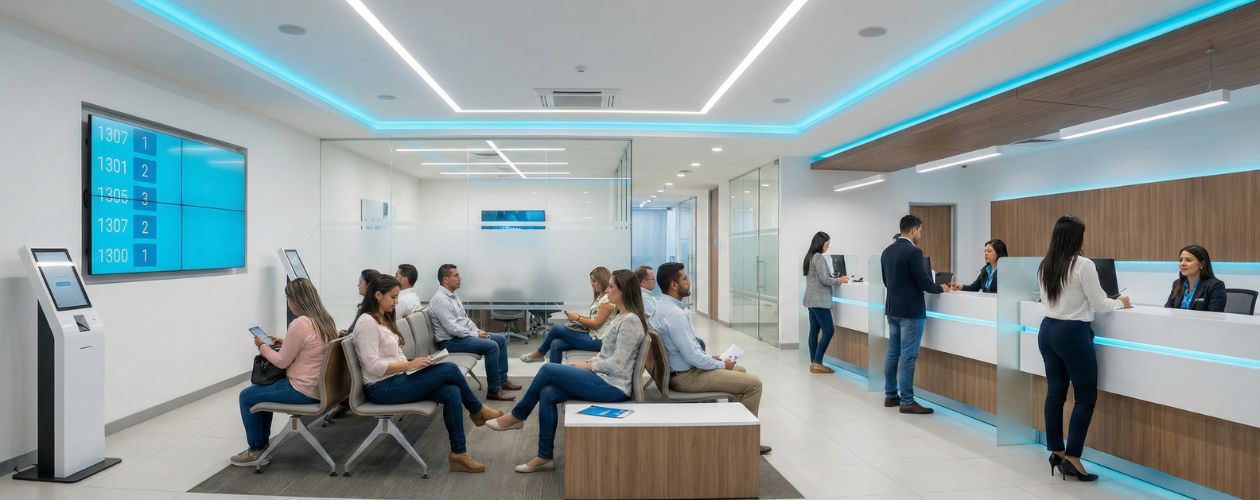
A queuing system isn’t just people standing around; it comprises three critical elements that define your branch’s efficiency:
Today, the “queue” is omnichannel. It includes users on hold, tickets pending in your CRM, and chat requests. Ignoring the science behind these flows is like navigating a ship without a compass.
“Wait time is the first metric of respect a brand shows its customers.”
Understanding the flow equation. For Ops Managers, Little’s Law is the formula that prevents location meltdown. While it looks academic, its logic is vital for workforce management and staffing.
The formula defines your system’s health:
Let’s break it down for business:
The strategic takeaway: If your branch is overcrowded (high L), and you don’t want to throttle sales by stopping entries (λ), the only mathematical solution is to drastically cut the Time in System (W). This is where Qanty’s technology hits the bottom line: streamlining flow without necessarily hiring more headcount.

The “High Utilization” Trap
Many managers push for 100% staff utilization. This is a fatal error. Mathematically, when utilization exceeds 85%, wait times don’t grow linearly—they spike exponentially. A system without slack collapses under the slightest variance.
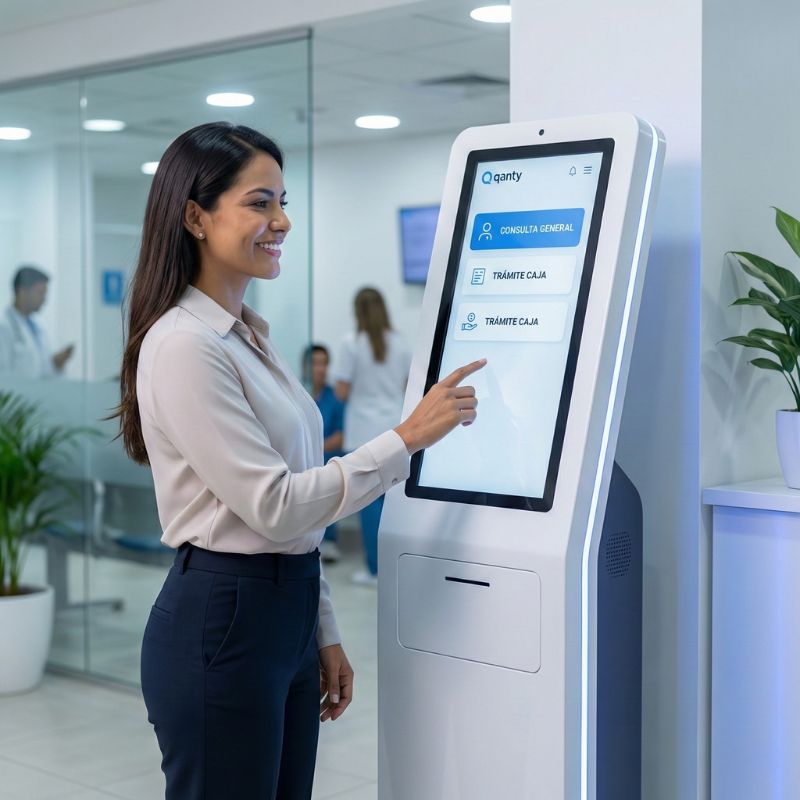
Managing emotions. David Maister, the renowned authority on service management, proved that customer satisfaction depends less on the stopwatch and more on how that time feels. Math (Little’s Law) handles the reality; psychology handles the perception.
Applying theory and psychology to improve your operation’s ROI.
The best line is the one that doesn’t exist. Allow users to “get in line” via Mobile or Web before they arrive. This reduces on-site congestion (L) without hurting business volume.
Not all transactions are created equal. Segment customers at entry (Kiosk/QR) to route quick tasks to express lanes, lowering the overall average wait time (W).
Broadcast estimated wait times on screens. Knowing “15 minutes remaining” gives control back to the customer and drastically reduces walk-away rates.
It enables precise workforce management based on actual demand, preventing overstaffing during lulls or service collapses during peak hours that lead to overtime and lost revenue.
It is the formula (L = λ × W) relating the number of people in your venue to service speed. It helps diagnose if congestion is a demand issue (marketing) or a throughput issue (operations).
Yes. Operationally and psychologically, the single line (like at Whole Foods or airports) is superior. It’s perceived as fairest (First In, First Out) and prevents one slow transaction from blocking an entire lane of customers.
Perceived wait time is often longer than actual time if the customer is anxious or bored. Digital signage and engagement strategies can reduce the perceived wait by up to 30%.
Platforms like Qanty provide web scheduling, virtual queuing, self-service kiosks, and digital signage, integrating data to optimize flow in real-time.

Let’s discuss how Qanty can improve operational efficiency at your U.S. locations.