OPTIMIZE, CONTROL
Boost your metrics with Qanty
Turn waiting into actionable data.
In the global market, time is the most undervalued asset on financial balance sheets, yet the costliest in terms of customer experience. For a healthcare user or a bank client, a crowded waiting room is a nuisance; for an Operations Director, it is a hidden cost that bleeds profitability and drives churn toward the competition.

Queue Theory, Flow Optimization, and Customer Experience (CX) are not isolated concepts; they are the mathematical foundation of operational efficiency. Discover how to transform passive waiting into a loyalty-building opportunity.
Queue Theory is the mathematical study of waiting lines and service flows. Its business objective is to find the optimal financial balance between the cost of increasing service capacity and the opportunity cost of losing customers due to excessive delays.
The balance between cost and service. Often, companies in sectors such as healthcare, banking, or government view lines simply as “excess demand.” However, under the lens of operational intelligence, a queue is a symptom of process misalignment.
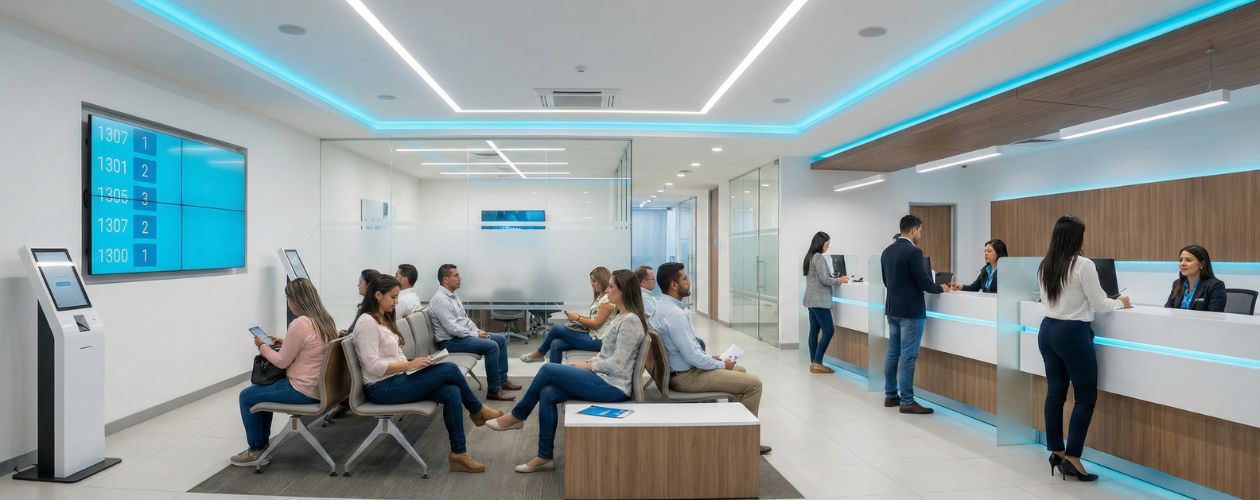
A queuing system is not just about people standing and waiting; it is composed of three critical elements that define the efficiency of your branch:
Today, the “queue” is not just physical. It includes users on hold on the phone, chats waiting for a response, and pending paperwork. Ignoring the science behind these flows is navigating operations blindly.
“Waiting time is the first indicator of respect a brand shows towards its users.”
Understanding the flow equation. For operations managers, Little’s Law is the compass that prevents branch collapse. Although it seems complex, its logic is vital for staff sizing.
The formula defines the health of your system:
Let’s break it down in business terms:
The strategic implication: If your branch is overwhelmed (high L), and you don’t want to stop sales by preventing entry (λ), the only mathematical solution is to drastically reduce the time in system (W). This is where Qanty’s technology makes an impact: streamlining flow without necessarily requiring more staff.

Why does “High Utilization” fail?
Many managers want their advisors busy 100% of the time. This is a mistake. Mathematically, when utilization exceeds 85%, wait times do not grow linearly, but exponentially. A system without “breathing room” collapses under any minor unforeseen event.
Managing emotions. David Maister, a world authority on service management, demonstrated that customer satisfaction depends not only on clocked minutes but on how that time feels. Mathematics (Little’s Law) handles reality; psychology handles perception.
Applying theory and psychology to improve your operation’s ROI.
The best line is the one that doesn’t exist. Allow your users to take a turn via WhatsApp or Web before arriving. This reduces L (people on-site) without affecting business.
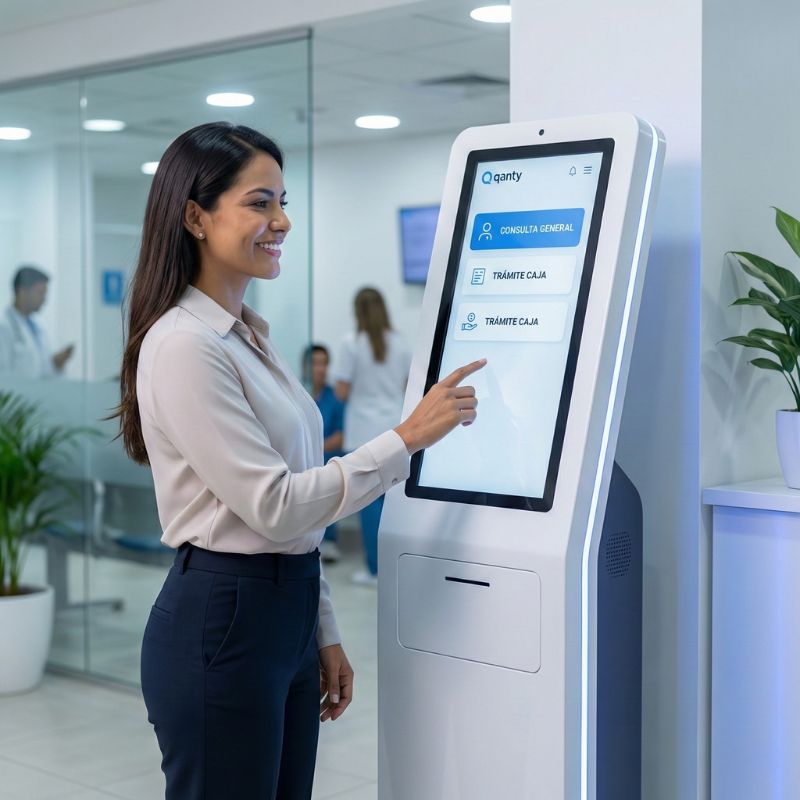
Not all transactions are equal. Segment your customers at the entrance (Kiosk or QR) to direct quick cases to express lanes, lowering the overall average wait time (W).
Display estimated wait times on screens. Knowing that “20 minutes” remain gives control to the user and drastically reduces the abandonment rate.
It allows for correct staff sizing based on real demand, avoiding idle advisors during off-peak hours or collapses during peak hours that generate overtime and customer loss.
It is the formula (L = λ × W) that relates the number of people in your location to the speed of service. Applying it helps identify if the congestion problem is due to demand (marketing) or response capacity (operations).
Psychologically and operationally, the single line is superior. It is perceived as fairer (first come, first served) and is more efficient because it prevents a slow transaction at one counter from delaying a specific group of people.
Perceived time is usually longer than real time if the customer is anxious or bored. Strategies like informative screens or in-room entertainment can reduce wait perception by up to 30%.
Solutions like Qanty offer web scheduling, virtual queues, self-service kiosks, and digital signage, integrating all data to optimize flow in real-time.

Let’s talk about how Qanty can improve the operational efficiency of your branches globally.